When making investment decisions, one of the most important questions investors ask is: “How long will it take to recover my investment?” This is where the concept of the Payback Period becomes extremely useful. It is one of the simplest and most widely used techniques in investment analysis, especially for beginners.
What is Payback Period?
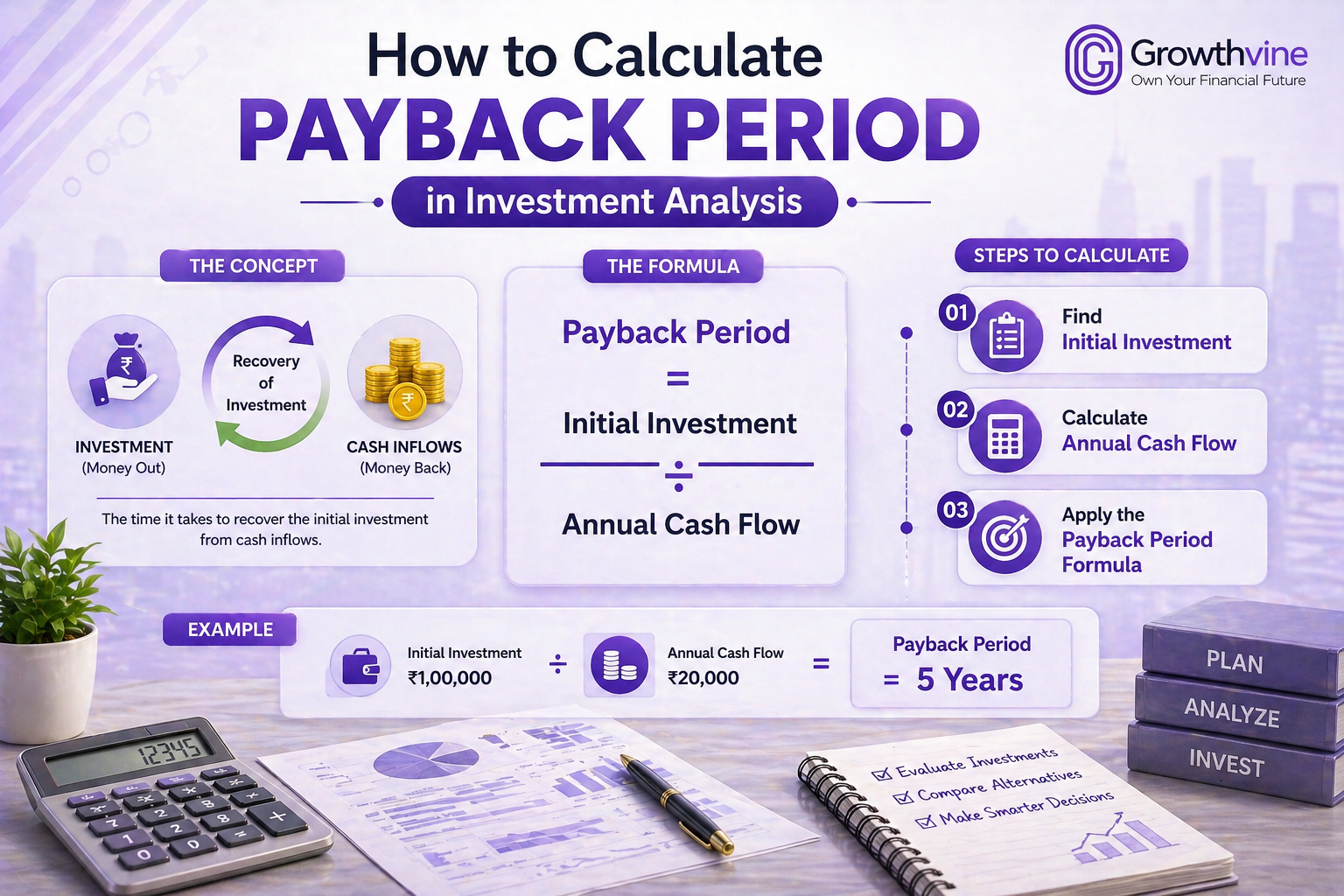
The Payback Period is the time required to recover the initial investment from the cash inflows generated by a project.
It tells you how quickly you get your money back.
For example, if you invest ₹10,000 and earn ₹2,000 per year, your payback period is 5 years.
Why Payback Period is Important
The payback period is widely used because it is:
- Easy to calculate
- Simple to understand
- Useful for quick decision-making
- Helpful in assessing investment risk
Shorter payback periods are generally preferred because they indicate:
- Faster recovery of investment
- Lower risk
- Better liquidity
Basic Formula of Payback Period
The formula is:
Payback Period = Initial Investment ÷ Annual Cash Inflow
Step-by-Step Calculation
understand this with a simple example.
Example:
- Initial Investment = ₹50,000
- Annual Cash Inflow = ₹10,000
Payback Period = 50,000 ÷ 10,000 = 5 years
This means it will take 5 years to recover the investment.
Uneven Cash Flow Case
In real life, cash inflows are not always equal. In such cases, we calculate payback period step by step.
Example:
| Year | Cash Inflow (₹) |
| 1 | 10,000 |
| 2 | 15,000 |
| 3 | 20,000 |
| 4 | 10,000 |
Initial Investment = ₹40,000
Calculation:
- Year 1 → 10,000 (Remaining: 30,000)
- Year 2 → 15,000 (Remaining: 15,000)
- Year 3 → 20,000 (Investment recovered here)
Payback Period = 2 + (15,000 ÷ 20,000)
= 2.75 years
Interpretation of Payback Period
- Short Payback Period → Good investment (low risk)
- Long Payback Period → Risky investment
Companies often set a maximum acceptable payback period. Projects exceeding this limit are rejected.
Advantages of Payback Period
1. Simplicity
It is very easy to calculate and understand, even for beginners.
2. Focus on Liquidity
It emphasizes quick recovery of funds, which is important for businesses.
3. Risk Reduction
Shorter payback means less exposure to uncertainty.
Limitations of Payback Period
1. Ignores Time Value of Money
It does not consider that money today is more valuable than money in the future.
2. Ignores Profit After Payback
It only focuses on recovery, not on total profitability.
3. Not Suitable for Long-Term Projects
It may reject profitable projects with longer payback periods.
Use of Payback Period in Real Life
Payback period is commonly used in:
- Business investment decisions
- Startup funding analysis
- Machinery or equipment purchase
- Project feasibility studies
It is often used along with other methods like NPV and IRR for better decision-making.
How to Calculate Payback Period in Excel
Tools like Microsoft Excel make calculations easier.
You can:
- List yearly cash flows
- Use cumulative totals
- Identify the year when investment is recovered
This helps in faster and more accurate analysis.
Growthvine’s Perspective on Payback Period
At Growthvine, we believe that while the payback period is a useful starting point, it should not be the only decision-making tool.
We help investors:
- Analyze complete financial performance
- Combine payback with advanced methods
- Make balanced and informed investment decisions
Our approach ensures that you don’t just recover your investment—but also maximize long-term returns.
Final Thoughts
The payback period is one of the most practical tools in investment analysis. It gives a clear idea of how long your money will be tied up in an investment, helping you make safer and faster decisions.
However, smart investing is not just about recovering money—it’s about growing it. By combining payback period analysis with expert guidance from Growthvine, you can build a strategy that balances risk, return, and long-term success.
If you want to make smarter investment decisions, understanding concepts like payback period is the first step toward financial confidence and growth.

CFA-certified investment advisor with 15+ years of experience at Morgan Stanley, BofA Merrill Lynch, and Fidelity. SEBI-registered advisor (INA000018665).