
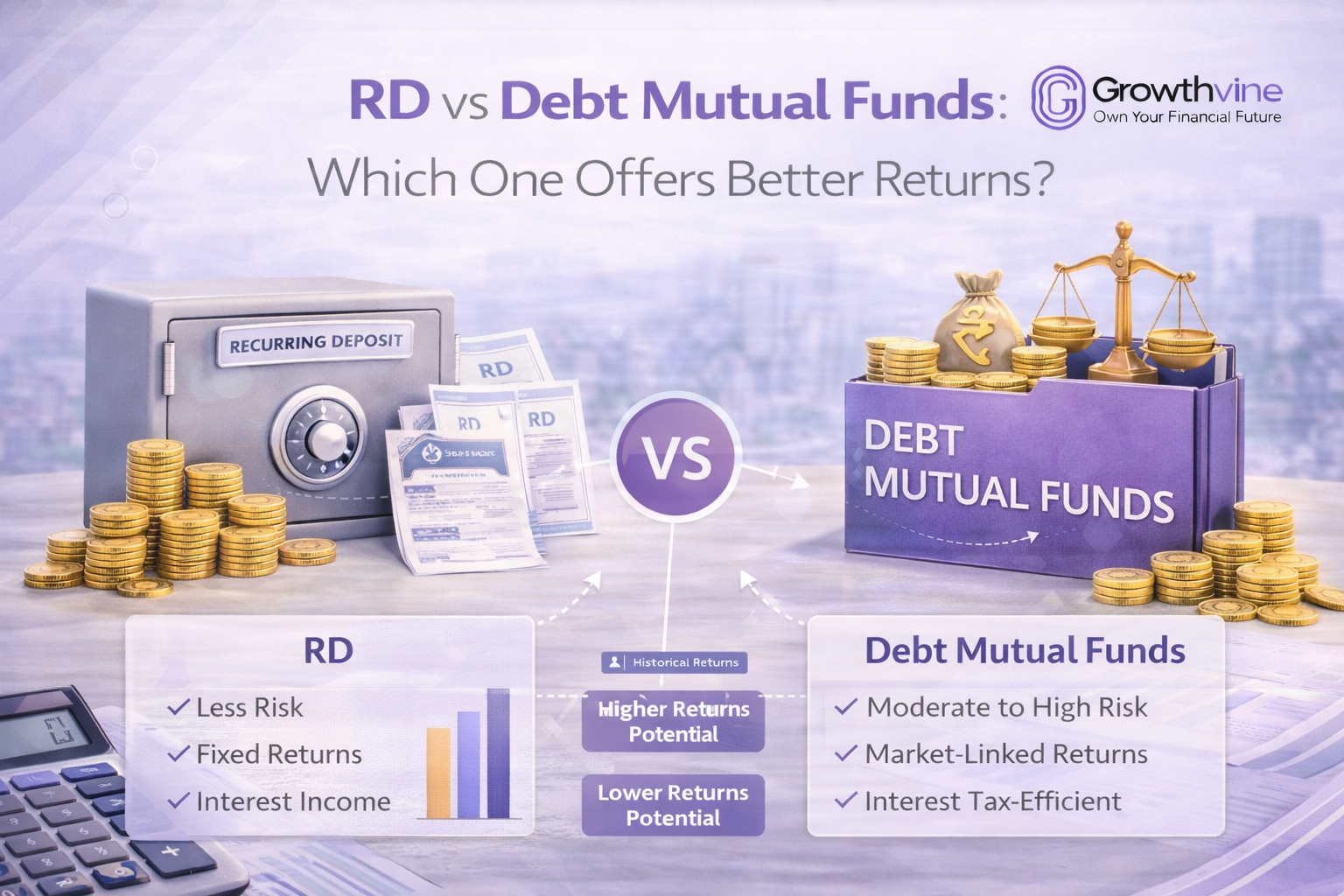
When it comes to safe and stable investment options, many investors in India often compare Recurring Deposits (RDs) and Debt Mutual Funds. Both are popular choices for individuals who want relatively low-risk investments while earning steady returns. However, choosing between them depends on your financial goals, risk appetite, liquidity needs, and tax considerations.
If you are confused about which option suits you best, you’re not alone. Many investors consult a mutual fund expert or a professional financial consultant to understand which investment aligns with their long-term strategy.
What is a Recurring Deposit (RD)?
A Recurring Deposit (RD) is a savings scheme offered by banks where you invest a fixed amount every month for a specific period. It is similar to a fixed deposit but allows regular contributions instead of a lump sum investment.
Key Features of RD:
- Fixed monthly investment
- Guaranteed returns
- Fixed interest rate
- Low risk
- Pre-defined tenure
RDs are ideal for conservative investors who prefer predictability and stability. Many individuals planning short-term goals rely on RDs as a disciplined savings tool.
What are Debt Mutual Funds?
Debt mutual funds are investment funds that invest in fixed-income instruments such as government bonds, corporate bonds, treasury bills, and money market instruments.
Unlike RDs, debt funds do not offer fixed returns. Their returns depend on interest rates, bond yields, and market conditions.
A mutual fund expert can help investors choose the right type of debt fund based on their financial goals and risk tolerance.
RD vs Debt Mutual Funds: Key Differences
1. Returns
RDs offer fixed returns, which are decided at the time of investment. While they are stable, the returns are usually moderate and may not beat inflation.
Debt mutual funds, on the other hand, offer market-linked returns. In many cases, they can generate higher returns than RDs, especially over longer periods.
If you are looking to maximize returns, consulting a financial advisor in Mumbai or a financial planner in Bangalore can help you identify better-performing debt funds.
2. Risk
RDs are considered very low-risk investments because they are backed by banks and offer guaranteed returns.
Debt mutual funds carry moderate risk, as their performance depends on market conditions, interest rate movements, and credit quality of bonds.
However, certain debt funds like government securities funds are relatively safer.
A financial consultant can help you balance risk and return while choosing the right investment option.
3. Liquidity
Liquidity is an important factor when choosing an investment.
- RDs usually have a fixed tenure, and premature withdrawal may lead to penalties.
- Debt mutual funds are generally more liquid, allowing investors to redeem their investments anytime (subject to exit load in some cases).
If you need flexibility, debt mutual funds may be a better option.
4. Taxation
Taxation plays a major role in determining actual returns.
- RD interest is fully taxable as per your income tax slab.
- Debt mutual funds may offer better tax efficiency, especially when held for longer durations.
A financial advisor in Chennai can help you plan your investments in a tax-efficient manner.
5. Investment Flexibility
RDs require a fixed monthly contribution, and missing payments may lead to penalties.
Debt mutual funds offer more flexibility, allowing both lump sum investments and SIP options.
This makes debt funds more suitable for investors who want flexibility in their investment strategy.
When Should You Choose RD?
Recurring Deposits may be suitable if you:
- Prefer guaranteed returns
- Have a low risk appetite
- Want to save for short-term goals
- Need disciplined monthly savings
For conservative investors, RDs remain a reliable option.
When Should You Choose Debt Mutual Funds?
Debt mutual funds may be a better choice if you:
- Want higher potential returns than RDs
- Need liquidity and flexibility
- Are comfortable with moderate risk
- Want tax-efficient investments
Many investors consult a mutual fund expert or a financial advisor in Mumbai to choose suitable debt funds based on their financial goals.
Which One Offers Better Returns?
The answer depends on your investment horizon and financial priorities.
- Short-term investors who prioritize safety may prefer RDs.
- Long-term investors looking for better returns and tax efficiency may benefit more from debt mutual funds.
In many cases, debt mutual fund have the potential to deliver higher post-tax returns compared to RDs, especially for investors in higher tax brackets.
However, risk tolerance and financial goals should always guide your decision.
Why Professional Financial Guidance Matters
Choosing between RDs and debt mutual funds is not always straightforward. Investors need to consider multiple factors such as risk, returns, tax implications, and financial goals.
A professional financial consultant or experienced mutual fund expert like Growthvine can help:
- Analyze your financial goals
- Compare investment options
- Create a diversified portfolio
- Optimize tax efficiency
- Monitor and adjust investments
Many investors today search for a financial planner in Bangalore, a financial advisor in Mumbai, or a financial advisor in Chennai to receive personalized financial guidance.
How Growthvine Helps You Make Smarter Investment Decisions
At Growthvine, the focus is on helping investors make informed financial decisions through expert guidance and personalized strategies. Whether you are a beginner or an experienced investor, Growthvine provides comprehensive financial advisory services tailored to your needs.
With a team of experienced professionals including mutual fund experts, financial consultants, and advisors across major cities, Growthvine helps investors choose the right investment options based on their financial goals and risk profile.
From selecting the right debt mutual fund to planning stable investment strategies, Growthvine ensures that your portfolio is well-balanced and aligned with your long-term objectives.
Final Thoughts
Both Recurring Deposits and Debt Mutual Funds have their own advantages and serve different financial needs. While RDs offer stability and guaranteed returns, debt mutual funds provide flexibility and the potential for higher returns.
The best choice depends on your financial goals, risk tolerance, and investment horizon. By seeking guidance from a trusted mutual fund expert or experienced financial consultant, you can make smarter decisions and build a strong financial future.
With expert support from Growthvine, you can confidently choose the right investment strategy and work toward achieving your long-term financial goals.

CFA-certified investment advisor with 15+ years of experience at Morgan Stanley, BofA Merrill Lynch, and Fidelity. SEBI-registered advisor (INA000018665).