
When investing in mutual funds, most investors focus only on returns. However, returns alone do not give the full picture of a fund’s performance. A good investment should not only generate returns but should also manage risk effectively. This is where the Sharpe Ratio becomes an important metric for evaluating mutual funds.
Understanding the Sharpe Ratio can help investors make smarter investment decisions and compare different mutual funds more effectively. Many investors also seek guidance from a mutual fund consultant or online mutual fund advisor like Growthvine to interpret such financial metrics before investing.
What is the Sharpe Ratio?
The Sharpe Ratio is a financial metric used to measure the risk-adjusted return of an investment. In simple terms, it shows how much return a mutual fund generates for every unit of risk taken.
The concept was introduced by Nobel Prize-winning economist William F. Sharpe, and it has become one of the most widely used tools for evaluating investment performance.
The basic idea behind the Sharpe Ratio is simple:
Higher returns are good, but higher returns with lower risk are even better.
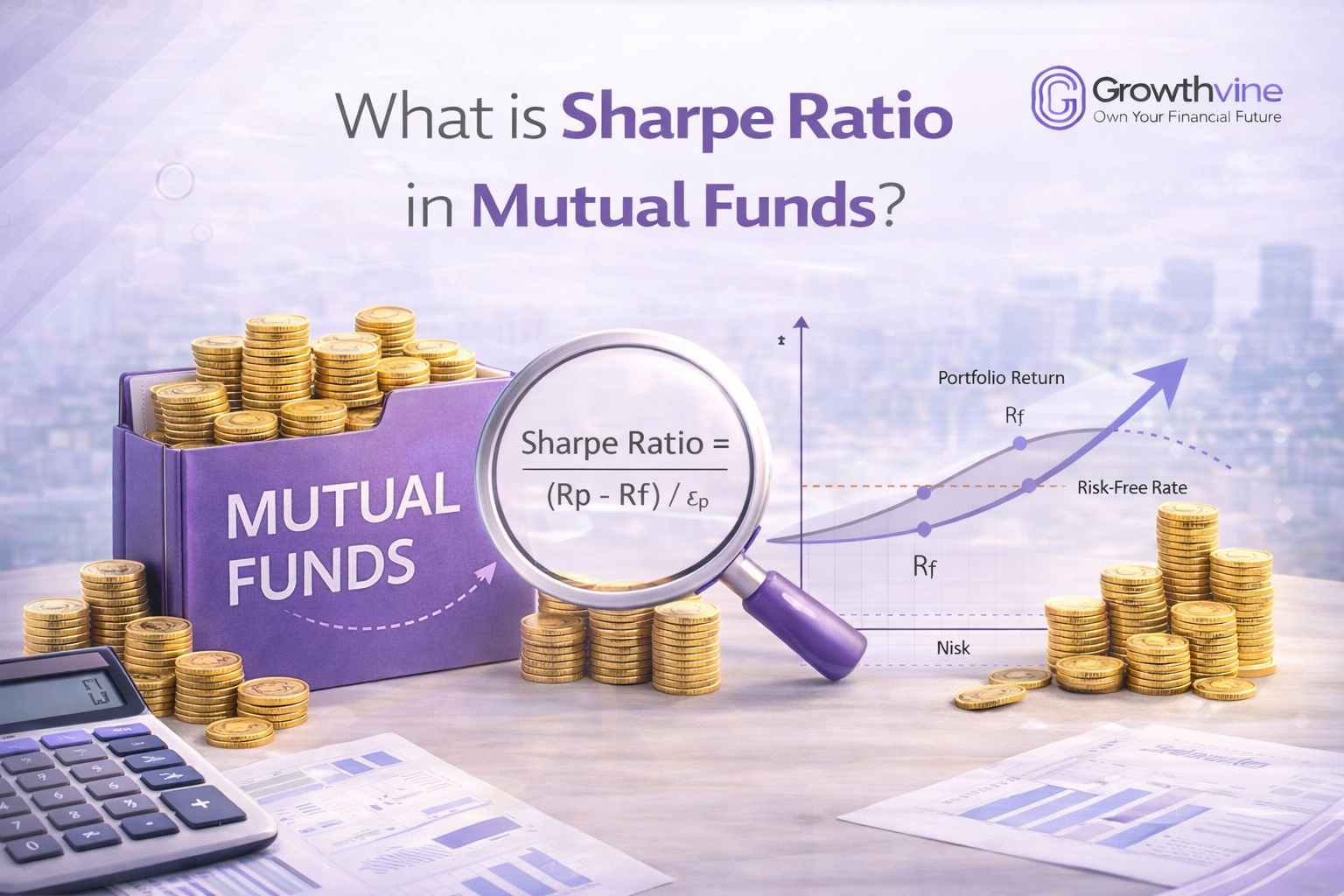
The formula for the Sharpe Ratio is:
Sharpe Ratio = (Return of the Fund – Risk-Free Rate) / Standard Deviation
Where:
- Return of the Fund refers to the average return generated by the mutual fund.
- Risk-Free Rate refers to the return from a risk-free investment such as government treasury bonds.
- Standard Deviation measures the volatility or risk associated with the fund.
Because this calculation can be complex for beginners, many investors prefer consulting a mutual fund expert or a professional mutual fund consultant to understand how the Sharpe Ratio affects their investment decisions.
Why is the Sharpe Ratio Important for Mutual Fund Investors?
The Sharpe Ratio helps investors understand whether a mutual fund’s returns are worth the risk taken.
1. Measures Risk-Adjusted Returns
Two mutual funds may offer the same returns, but one may involve higher risk. The Sharpe Ratio helps investors identify which fund provides better returns for the level of risk involved.
2. Helps Compare Different Mutual Funds
Investors often compare multiple funds before investing. The Sharpe Ratio makes it easier to compare funds based on risk-adjusted performance rather than just returns.
3. Evaluates Fund Manager Performance
A high Sharpe Ratio indicates that the fund manager has been able to generate higher returns without taking excessive risks.
Because evaluating multiple financial metrics can be confusing, many investors rely on a mutual fund advisor in Mumbai or a mutual fund planner in Bangalore for professional guidance.
How to Interpret the Sharpe Ratio
Understanding how to read the Sharpe Ratio is important for making better investment decisions.
- Sharpe Ratio less than 1: Indicates that the returns are not very attractive compared to the risk taken.
- Sharpe Ratio between 1 and 2: Considered good and indicates reasonable risk-adjusted returns.
- Sharpe Ratio above 2: Considered very strong and indicates excellent performance relative to risk.
For example, if two mutual funds generate similar returns but one has a higher Sharpe Ratio, the fund with the higher ratio is generally considered the better investment option.
An experienced mutual fund expert or online mutual fund advisor can help investors analyze these ratios across different funds and choose the most suitable option.
Example of Sharpe Ratio in Mutual Funds
Let’s understand this with a simple example.
Suppose there are two mutual funds:
- Fund A gives an average return of 12% with moderate risk.
- Fund B gives an average return of 12% but with higher volatility.
Even though both funds offer the same returns, Fund A may have a higher Sharpe Ratio because it achieves the same returns with lower risk.
This means Fund A may be a better choice for investors seeking stable performance.
When selecting funds based on such financial metrics, consulting a mutual fund consultant or a mutual fund advisor in Mumbai can help investors make more informed decisions.
Limitations of the Sharpe Ratio
Although the Sharpe Ratio is a useful tool, it also has some limitations.
1. Depends on Historical Data
The Sharpe Ratio is calculated based on past performance, which may not always predict future results.
2. Does Not Capture All Types of Risk
The ratio mainly measures volatility and may not account for other forms of risk such as market shocks or liquidity risks.
3. Should Not Be Used Alone
Investors should evaluate other factors such as fund objectives, expense ratio, portfolio composition, and long-term performance before investing.
This is why many investors prefer working with a mutual fund planner in Bangalore or a professional online mutual fund advisor who can evaluate multiple performance indicators.
How Professional Advisors Help Investors
Choosing the right mutual fund involves more than just analyzing returns or financial ratios. Professional guidance can help investors build a diversified portfolio aligned with their financial goals.
A professional mutual fund expert can help investors:
- Analyze risk-adjusted returns using metrics like the Sharpe Ratio
- Compare multiple mutual fund schemes
- Create a diversified investment portfolio
- Align investments with long-term financial goals
- Monitor and rebalance portfolios when needed
Investors seeking personalized investment strategies often consult an experienced mutual fund consultant or work with an online mutual fund advisor for convenience and expert insights.
Why Choose Growthvine for Mutual Fund Advisory
At Growthvine, the focus is on helping investors make well-informed investment decisions through professional guidance and strategic financial planning. The company provides reliable support through experienced professionals including a mutual fund advisor in Mumbai, a mutual fund planner in Bangalore, and trusted online mutual fund advisors.
With a team of experienced mutual fund experts, Growthvine helps investors understand key investment metrics like the Sharpe Ratio and choose the right mutual funds based on their financial goals, risk tolerance, and long-term wealth creation strategies.
Final Thoughts
The Sharpe Ratio is an essential metric for evaluating mutual fund performance, as it measures returns relative to risk. By understanding this ratio, investors can compare funds more effectively and choose investments that offer better risk-adjusted returns.
However, financial metrics alone should not determine investment decisions. Working with a knowledgeable mutual fund consultant or experienced mutual fund expert can help investors build a well-balanced portfolio and make smarter financial choices.
If you are looking for expert guidance, Growthvine offers trusted financial support through experienced advisors, including mutual fund advisor in Mumbai, mutual fund planner in Bangalore, and professional online mutual fund advisors, helping investors achieve their financial goals with confidence.

CFA-certified investment advisor with 15+ years of experience at Morgan Stanley, BofA Merrill Lynch, and Fidelity. SEBI-registered advisor (INA000018665).