Mutual fund investors are familiar with open-ended and closed-ended schemes, but there is another lesser-known category that falls between the two, which is interval funds. Such funds are a combination of both open-ended and closed-ended mutual funds, offering controlled liquidity while still allowing investors to benefit from long-term growth.
The way interval funds operate will assist investors in diversifying their portfolios better. Interval funds can be strategically applied with respect to specific financial objectives with the guidance of a mutual fund investment planner.
What Are Interval Funds?
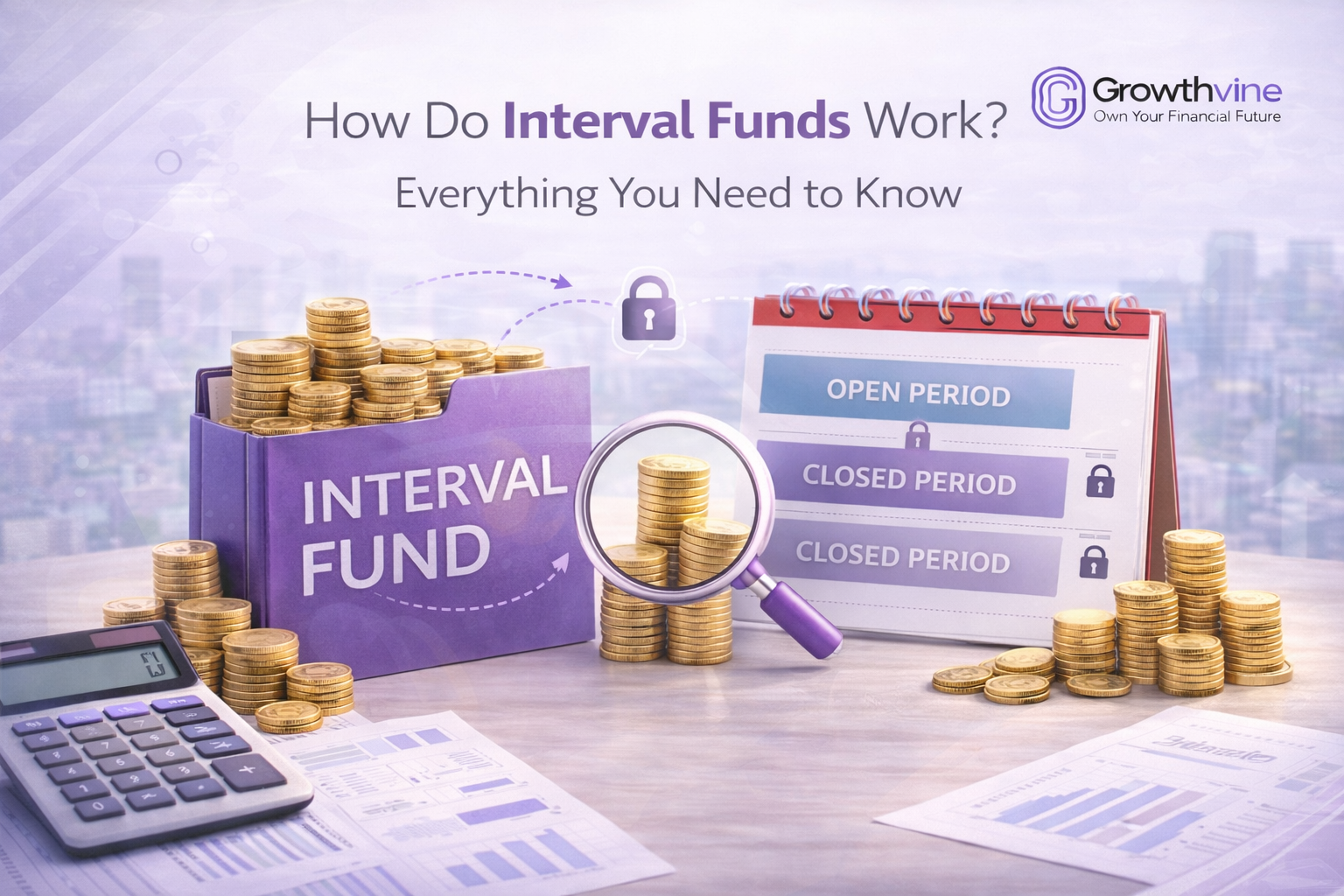
Interval funds are a type of mutual fund whereby the investor can only buy or sell the units at a particular time, rather than daily. These intervals are predefined by the fund house and disclosed in the scheme documents.
A mutual fund planner tends to describe interval funds as a hybrid structure. They do this by providing liquidity periodically, and leave the fund managers to invest in comparatively less liquid assets that can more likely give better returns in the long run.
How Interval Funds Work
Interval funds operate with a fixed maturity structure, but unlike closed-ended funds, they open for transactions at periodic intervals. Such periods may be monthly, quarterly, or semi-annually, depending on the different schemes.
A mutual fund consultant typically outlines the process as follows:
- The fund remains closed for daily transactions.
- At predetermined intervals, investors can buy or redeem units.
- NAV is calculated at the time of the interval.
This controlled liquidity allows fund managers to focus on long-term strategies without worrying about daily redemption pressures.
Key Features of Interval Funds
Interval funds have distinct characteristics that set them apart from other mutual fund types.
-
Limited Liquidity
Unlike open-ended funds, interval funds do not allow daily entry and exit. A mutual fund advisor ensures the investor understands and feels comfortable with this liquidity structure.
-
Structured Investment Horizon
Interval funds are appropriate for investors who have specific investment horizons. A mutual fund planner tends to match them with mid- to long-term financial targets.
-
Portfolio Flexibility
This means that the fund managers experience reduced redemption risk and may invest in instruments that have longer maturity or reduced liquidity, which may increase returns.
Types of Assets Held by Interval Funds
The interval funds usually invest in a combination of:
- Debt and money market instruments.
- Structured credit products.
- Choose equity-linked products.
A mutual fund investment planner evaluates portfolio composition carefully, as asset quality plays a crucial role in performance.
Interval Funds vs Open-Ended and Closed-Ended Funds
It is important to know the difference between interval funds and the conventional mutual fund structure.
| Feature | Open-Ended Funds | Closed-Ended Funds | Interval Funds |
| Liquidity | Daily | At maturity | Periodic |
| Entry/Exit | Anytime | Limited | At intervals |
| Investment Horizon | Flexible | Fixed | Semi-flexible |
| Suitability | All investors | Long-term | Goal-based |
Interval funds are frequently offered by a mutual fund consultant to investors who are willing to seek a balance between liquidity and return optimization.
Who Should Invest in Interval Funds?
Interval funds are not suitable for everyone. They are usually recommended by a mutual fund advisor to those investors who:
- Average risk appetite.
- Not in need of urgent liquidity.
- Will favor systematic investment plans.
- Demand diversification outside of conventional funds.
They are effective for the investors who have excess funds but not emergency funds.
Benefits of Interval Funds
With interval funds, a mutual fund planner points out several benefits:
- Less effect of regular redemptions.
- Potentially better yield due to long-term holdings.
- Vigorous investment discipline.
These characteristics make interval funds appealing to those investors who are concerned with stability, as opposed to short-term returns.
Risks and Limitations of Interval Funds
In spite of these advantages, interval funds have some risks.
A mutual fund consultant warns investor against:
- Liquidity constraints during non-interval periods.
- Asset mix, market and credit risk.
- Risks of missing redemption windows.
These risks should be understood in advance before investing money.
Taxation of Interval Funds
The taxation of interval funds is based on the asset composition. A mutual fund investment planner ensures investors understand applicable tax rules.
- Debt interval funds are taxed as debt mutual funds.
- Equity-based interval funds are taxed just like equity funds.
- Capital gains are dependent on the holding period.
The process of tax planning is necessary to maximize post-tax returns.
How Interval Funds Fit into a Portfolio
Interval funds are best used as supplementary investments. A mutual fund advisor incorporates them into portfolios to:
- Enhance diversification
- Improve risk-adjusted returns
- Support medium-term goals
They are not supposed to substitute the equity or debt holdings.
Common Mistakes Investors Should Avoid
A mutual fund planner will frequently caution against:
- Making investments without being aware of the limitations of liquidity.
- Targeting interval funds as open-ended schemes.
- Disregard of asset quality and credit risk.
These errors can be prevented and, therefore, enhance the whole investment process.
Conclusion
Interval funds offer a unique blend of discipline, controlled liquidity, and long-term investment potential. While they are not suitable for all investors, they can play a meaningful role in well-structured portfolios.
With guidance from a mutual fund investment planner, investors can use interval funds strategically to meet specific financial objectives.
For expert guidance on evaluating and investing in interval funds as part of a balanced portfolio, connect with Aaneev Wealth and make informed mutual fund decisions with confidence.