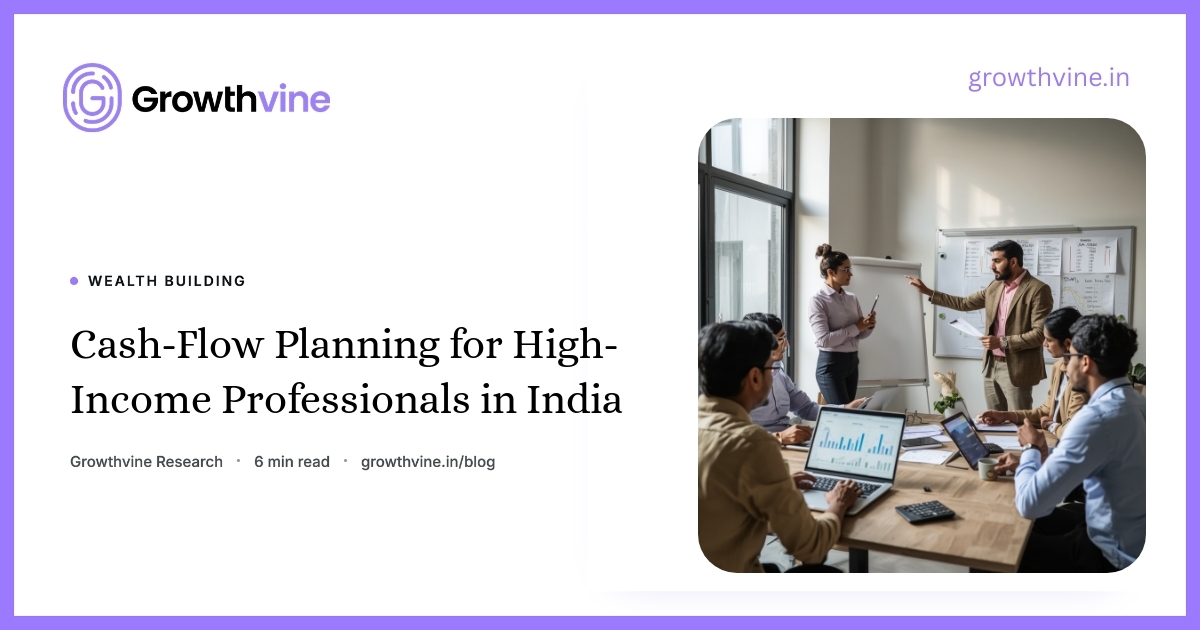
Imagine a senior CXO who receives a hefty annual bonus and holds significant ESOPs but finds themselves short of liquid cash when an unexpected expense arises. This paradox of being “cash poor but asset rich” is common among high-income professionals in India. Cash-flow planning is the disciplined approach that bridges this gap, ensuring your income, investments, and obligations align smoothly to preserve your lifestyle and meet your goals.
Why Cash-Flow Planning Matters for High-Income Professionals in India
Cash flow is the actual movement of money in and out of your hands, distinct from net worth, which includes illiquid assets like property or vested ESOPs. High-income professionals often face irregular pay structures—bonuses, commissions, ESOP vesting—that complicate liquidity. Without careful planning, you risk cash crunches despite a high net worth, overexposure to employer stock, and unexpected tax liabilities.
For example, nearly 40% of high-net-worth individuals in India hold concentrated employer stock, which can inflate paper wealth but offers limited liquidity and tax challenges when exercised.
Understand Your Cash-Flow Components — Income, Taxes, and Obligations
Your cash flow starts with your salary structure. The Cost to Company (CTC) includes base salary, allowances, perquisites, and employer contributions, but your take-home pay is after mandatory deductions like Provident Fund (PF), professional tax, and TDS. Variable pay such as bonuses and commissions adds complexity, as does income from ESOPs, rental properties, freelance consulting, or foreign sources for NRIs.
For instance, a sample salary slip might show a gross salary of Rs 2,00,000, with deductions of Rs 30,000, resulting in a net take-home of Rs 1,70,000. Understanding these components helps in accurate cash-flow forecasting and tax planning.
Design Cash-Flow Buckets: Liquidity, Goals, Growth, and Protection
Effective cash-flow planning segments your money into distinct buckets:
- Liquidity Bucket: Immediate cash needs and emergency fund, typically 6–12 months of essential expenses for stable roles, or up to 24 months if income is variable or employer concentration is high. Instruments include savings accounts, liquid mutual funds, and ultra-short duration funds.
- Goals Bucket: Short- to medium-term objectives like home down payment or education fees, funded through laddered debt instruments, fixed deposits, or hybrid mutual funds.
- Growth Bucket: Long-term wealth creation via equity mutual funds, ETFs, or specialized investment funds (SIFs) aligned with your risk profile.
- Protection Bucket: Insurance coverage (term, health, critical illness) and contingency reserves to safeguard cash flow against shocks.
A sample allocation for a balanced professional might be 15% liquidity, 25% goals, 50% growth, and 10% protection.
Managing Variable Compensation: Bonuses, ESOPs, and Irregular Income
Bonuses and ESOPs require disciplined handling to avoid lifestyle inflation and tax pitfalls. A practical rule for bonus allocation is:
- 50% for mandatory uses: taxes, debt repayment, emergency fund top-up
- 30% for goal funding: home, education, or other planned expenses
- 20% for growth or discretionary spending
For ESOPs, consider a staggered exercise and sale strategy to manage tax liabilities and reduce employer stock concentration. For example, if you receive ESOPs vesting annually, plan partial sales aligned with tax brackets to optimize capital gains treatment and maintain liquidity.
Income smoothing techniques, such as maintaining a separate buffer account funded by variable pay, help manage irregular cash inflows and prevent impulsive spending.
Tax and Regulatory Considerations That Affect Cash Flow
Understanding tax timing is crucial. High-income professionals must track TDS on salary and perquisites, including ESOP exercise and sale events. Advance tax payments may be required quarterly if your tax liability exceeds thresholds after TDS.
Capital gains tax rules differ for equities and real estate, with holding periods affecting rates. NRIs face additional considerations under FEMA for repatriation and foreign income declarations.
Practical Templates and Tools: Rolling Cash-Flow, Bucket Allocation, and Scenario Models
A rolling 12-month cash-flow template helps forecast income and expenses, incorporating salary, bonuses, ESOP vesting, taxes, and planned outflows. Fields include gross income, deductions, net income, fixed and variable expenses, and investment contributions.
Scenario analysis—such as job loss or relocation—can be modeled to assess liquidity needs and adjust allocations.
Insurance, Contingency Plans and Employer Concentration Risk
Term and health insurance should cover at least 10–15 times your annual income to protect dependents. Critical illness coverage adds a safety net for unexpected medical costs.
Employer stock concentration risk can be mitigated by scheduled partial sales and diversification into mutual funds or SIFs. Estate planning basics, including nomination and succession documents, ensure smooth wealth transfer.
Actionable 30/60/90-Day and Annual Implementation Checklists
- Immediate: Assess liquidity, review insurance coverage, and understand tax obligations.
- 30–90 Days: Allocate bonus per rule, set up automated transfers to buckets, and plan ESOP exercise/sale schedule.
- Annual: Review cash-flow projections, rebalance investments, and update tax planning.
Common Mistakes and How to Avoid Them
- Treating bonuses as discretionary rather than allocating systematically.
- Underfunding liquidity despite high net worth.
- Overconcentration in employer stock or illiquid real estate.
- Delaying tax planning until year-end.
- Using long lock-in investments for short-term needs.
FAQs and Next Steps
How much emergency fund should I maintain as a high-income professional in India? Aim for 6–12 months of essential expenses if your income is stable; increase to 12–24 months if you have variable pay or concentrated employer stock.
How should I allocate my annual bonus? Use the 50:30:20 rule—50% for taxes and essentials, 30% for goals, and 20% for growth or discretionary spending.
What is the best way to manage ESOPs and RSUs from a cash-flow perspective? Stagger exercises and sales to manage tax impact and liquidity, and avoid overexposure to employer stock.
Which instruments are best for short-term liquidity in India? Savings accounts, liquid mutual funds, and ultra-short duration funds offer varying liquidity and returns; choose based on your immediate needs and tax situation.
Do I need to pay advance tax if I get big bonuses or consulting income? Yes, if your tax liability after TDS exceeds prescribed limits, advance tax payments are mandatory quarterly.
How to prevent lifestyle inflation after a pay rise or bonus? Automate allocations, precommit to saving rules, and treat raises as phantom income to avoid impulsive spending.
Cash-flow planning for high-income professionals in India requires a disciplined, bucketed approach that integrates income variability, tax planning, and goal-based investing. Growthvine Capital offers research-driven guidance and technology-enabled tools to help you build and maintain a robust cash-flow plan tailored to your unique situation. To explore how to start your plan or get personalized advice, visit growthvine.in or contact a Growthvine advisor.
Disclosure: Growthvine Capital is an AMFI Registered Mutual Fund Distributor (ARN-176753). Mutual Fund and SIF investments are subject to market risks; please read all scheme-related documents carefully. PMS and AIF products, where referenced, are distributed in association with SEBI-registered providers and are subject to their respective regulations and risk profiles. Past performance is not necessarily indicative of future returns. This article is for educational purposes only and is not investment, tax, or legal advice.