When it comes to investing, there are many strategies that people follow. While they are aware that they should invest in different ways and form the right investment strategies, confusion arises when the terms asset allocation and diversification come into play. While the goal of both these strategies is broadly the same, that is, striking the right balance between risk and reward, they are still different from each other. Understanding asset allocation vs diversification, their importance, and the meaning and role of rebalancing is the key to efficient portfolio management.
In this blog, we will understand the difference between asset allocation and diversification and how these essential aspects can ensure long-term growth for investors. So, let’s get started!
Asset Allocation vs Diversification Explained: A Clear Understanding of the Differences
Let us understand asset allocation vs diversification better based on parameters like definition, example, purpose, etc.
Definition:
-
What is Asset Allocation in Investing?
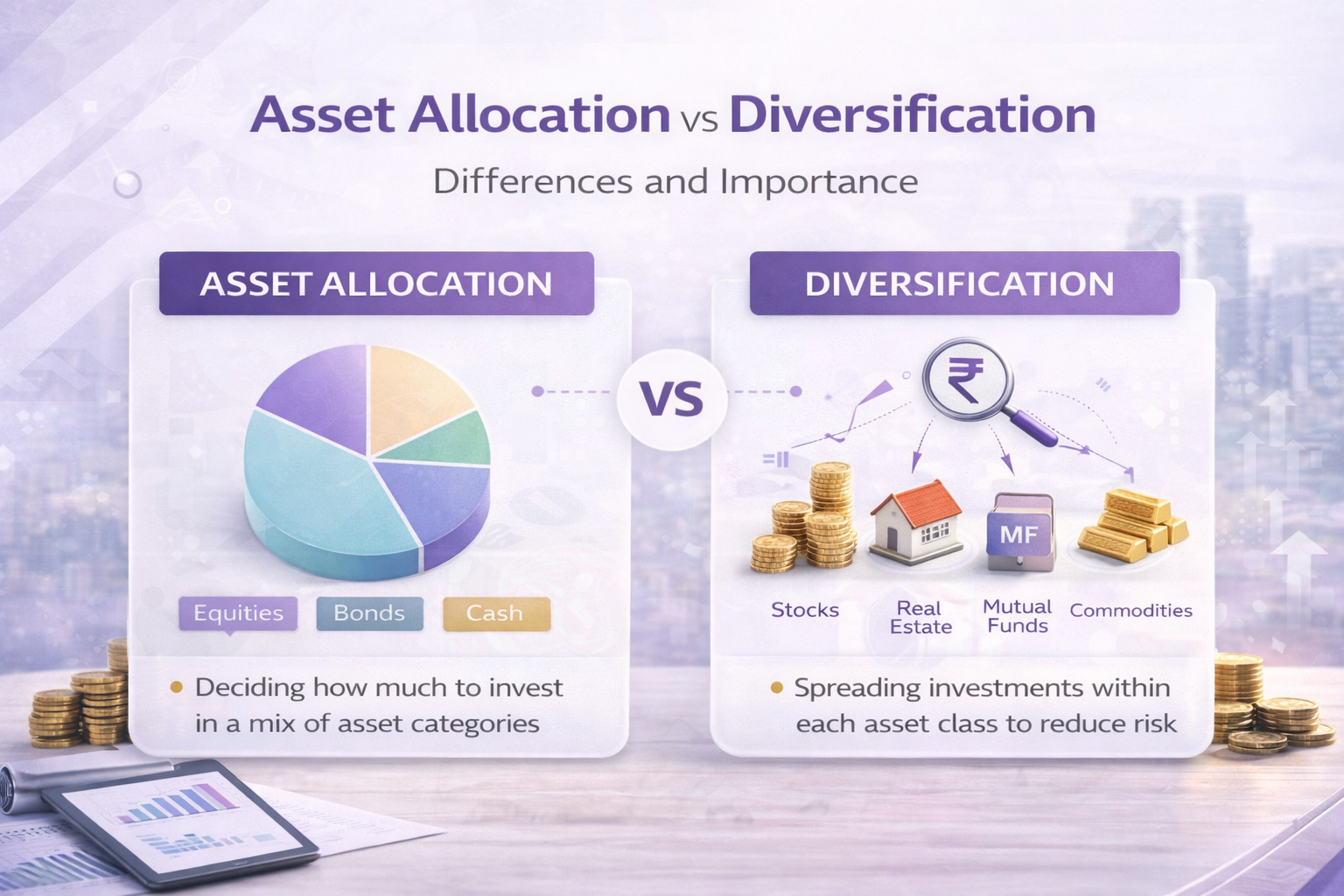
Asset allocation refers to dividing your investment portfolio across different classes, including equity, debt, gold, real estate, and other available alternatives. The percentage-wise division across these classes will differ based on your personal preferences, willingness to take risks, and how soon you may need the invested money. So, you need to form the asset allocation strategy accordingly.
-
What is Diversification in Investing?
Diversification is usually seen as a way to avoid major losses in your investments. When you invest in different categories under the same asset class, it is called diversification. This means that you don’t invest your money in a single stock, property, or other class. You spread it across different options, so that even if one performs poorly, the others gain you profits. A good diversification strategy is when you invest in a mix of large-cap, mid-cap, and small-cap stocks and mutual funds across different industries.
Purpose:
-
Importance of Asset Allocation:
The purpose of asset allocation is to balance your risks and returns based on your unique investment goals and risk appetite.
-
Importance of Diversification:
The purpose of diversification in portfolio management is to reduce risks by avoiding overexposure to a single investment, thereby stabilizing your portfolio.
Examples:
-
Example of Asset Allocation:
Here’s an asset allocation example:
Suppose Neeraj is a young working professional who has INR 1,00,00,000 to invest. His financial advisor recommends that he invest it across different classes in this way: 50% equity, 30% debt, 10% gold, 10% real estate. So, he will allocate his money across these as follows:
- INR 50,00,000 in equity
- INR 30,00,000 in debt
- INR 10,00,000 in gold
- INR 10,00,000 in real estate
-
Example of Diversification:
Here’s a diversification example:
Now, for reducing risks, Neeraj will further spread the 50% he wants to invest in equity across different options, keeping 20% each of large-cap and mid-cap, and 10% of small-cap funds.
So, for diversification, Neeraj will divide the INR 50,00,000 as:
- INR 20,00,000 in large-cap funds
- INR 20,00,000 in mid-cap funds
- INR 10,00,000 in small-cap funds
Strategy
- Asset Allocation Strategy: Asset allocation requires a macro-level strategy, which means that you work across asset classes.
- Diversification Strategy: Diversification requires a micro-level strategy, so investors need to work within each asset class.
Timeframe:
Another factor that varies in asset allocation vs diversification is the timeframe. While asset allocation is a long-term phenomenon, diversification requires an ongoing, proactive approach. So, assets can be reinvested annually or with changes in your life, but diversification needs to be balanced depending on how the market conditions change.
What is Rebalancing: Understanding Its Importance
Just knowing how asset allocation works and how diversification reduces risk is not enough; you should also consider time-to-time rebalancing for effective portfolio management and long-term growth.
Rebalancing means adjusting the proportions of various asset classes to ensure that they align with your risk tolerance levels and investment goals. Rebalancing is the shield that protects investors from the dynamic nature of the markets. Restoring the balance of your investments is essential if you want to use asset allocation and diversification for long-term growth.
Multiple approaches are available for rebalancing your investments, and making the right decision matters when money is on the line. A good idea is to work with a registered investment advisor who can offer strategic guidance.
Conclusion
Understanding asset allocation vs diversification is essential for every investor who wants to build a resilient portfolio. While asset allocation helps you decide which asset class you should be allocating the investments to, diversification focuses on how to spread investments within each class to reduce risk. Together, these strategies create a strong foundation for managing market volatility and achieving long-term growth. With regular rebalancing, you can also align your portfolio with the changing market scenarios. By using a thoughtful strategy and consulting a seasoned investment advisor, you can make informed decisions and fulfill your financial objectives.
Have further questions about asset allocation and diversification, or want a specialist to guide you? Come to GrowthVine and get the best help possible!