
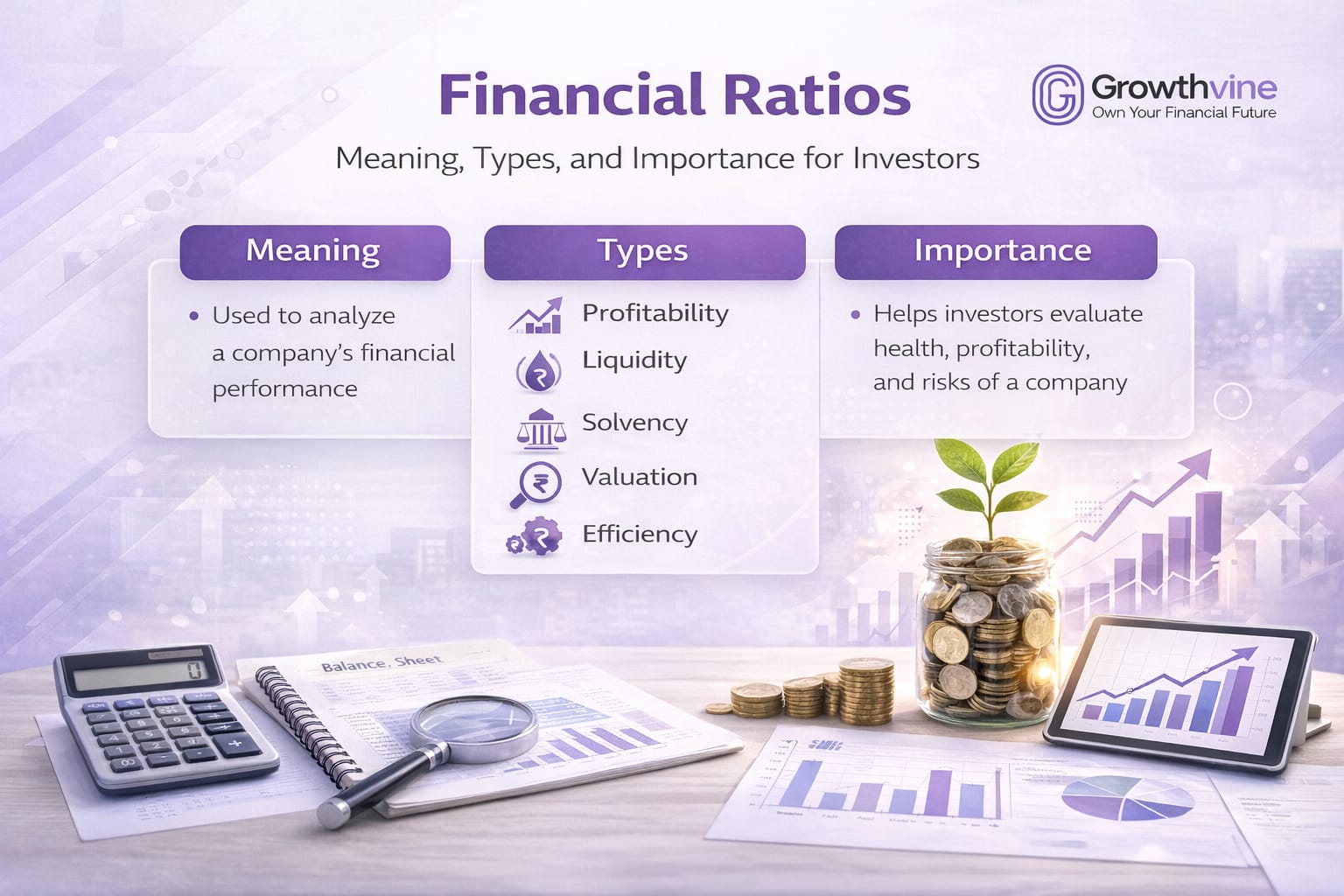
When investors analyze a company, looking only at its stock price or brand reputation isn’t enough. True financial strength lies in the numbers behind the business. That’s where financial ratios come in. They help investors evaluate a company’s performance, stability, and growth potential using simple mathematical comparisons.
At Growthvine, we believe informed investors make better decisions. With guidance from a certified financial planner, experienced financial consultant, or trusted personal financial consultant, understanding financial ratios becomes easier and far more useful in building a strong investment strategy.
What Are Financial Ratios?
Financial ratios are numerical relationships calculated from a company’s financial statements — such as its balance sheet, income statement, and cash flow statement.
These ratios help investors evaluate:
- Profitability
- Financial health
- Efficiency
- Liquidity
- Valuation
Instead of reading hundreds of numbers, financial ratios simplify analysis and allow investors to compare companies quickly.
A knowledgeable financial advisor near me Growthvine uses these ratios to help clients assess whether a company fits their investment portfolio.
Why Financial Ratios Are Important for Investors
Financial ratios provide insights that raw financial statements cannot easily show.
They help investors:
- Understand how efficiently a company operates
- Compare companies within the same industry
- Evaluate risk levels before investing
- Identify overvalued or undervalued stocks
- Track company performance over time
This structured analysis reduces emotional decision-making and improves long-term investment outcomes.
Types of Financial Ratios
Financial ratios are generally divided into four main categories.
1. Profitability Ratios
These ratios measure how well a company generates profits relative to revenue, assets, or shareholder equity.
Common examples include:
- Net Profit Margin – shows how much profit a company keeps from its revenue
- Return on Equity (ROE) – measures how effectively shareholder money is used
- Return on Assets (ROA) – evaluates how efficiently assets generate income
Strong profitability ratios often indicate a competitive and well-managed business.
A professional certified financial planner like Growthvine reviews these ratios when recommending equity investments to clients.
2. Liquidity Ratios
Liquidity ratios measure a company’s ability to meet short-term obligations.
Key examples include:
- Current Ratio – compares current assets to current liabilities
- Quick Ratio – measures ability to pay liabilities without selling inventory
Healthy liquidity ratios suggest the company can survive financial stress without operational disruption.
Investors seeking stability often pay close attention to these metrics.
3. Leverage Ratios
Leverage ratios evaluate how much debt a company uses to finance its operations.
Common examples include:
- Debt-to-Equity Ratio – compares total debt to shareholder equity
- Interest Coverage Ratio – shows ability to pay interest on debt
A company with excessive debt may face risks during economic downturns. That’s why a skilled financial consultant often evaluates leverage before suggesting investments.
4. Valuation Ratios
Valuation ratios help investors determine whether a stock is fairly priced.
Important examples include:
- Price-to-Earnings (P/E) Ratio – compares share price to earnings
- Price-to-Book (P/B) Ratio – compares market value to asset value
- Dividend Yield – shows income generated from dividends
These ratios help investors decide whether a stock is undervalued, fairly valued, or overpriced.
A trusted personal financial consultant Growthvine may use valuation ratios to identify long-term investment opportunities.
How Investors Should Use Financial Ratios
Financial ratios should not be viewed in isolation. Instead, investors should:
- Compare ratios within the same industry
- Track ratios over several years
- Combine multiple ratios for better insights
- Evaluate ratios alongside market conditions
A company with strong profitability but excessive debt, for example, may not be a safe investment.
That’s why professional guidance often makes a big difference in interpreting these numbers correctly.
How Growthvine Helps Investors Analyze Financial Ratios
At Growthvine, we simplify financial analysis for investors who want to make informed decisions without getting lost in complex data.
Our team of professionals, including experienced certified financial planners, knowledgeable financial consultants, and trusted advisors, helps clients:
- Evaluate company fundamentals
- Compare investment opportunities
- Understand financial risks clearly
- Build diversified portfolios
- Align investments with long-term goals
This structured approach ensures that financial ratios become a useful decision-making tool rather than confusing statistics.
Final Thoughts
Financial ratios are one of the most powerful tools available to investors. They transform complex financial statements into meaningful insights and help you evaluate companies with confidence.
Whether you are investing in stocks, mutual funds, or building a long-term portfolio, understanding financial ratios can significantly improve your decision-making.
If you’re unsure how to interpret these numbers, working with a certified financial planner, experienced financial consultant, or trusted personal financial consultant at Growthvine can help you turn data into actionable investment strategies.
Because successful investing isn’t just about choosing companies — it’s about understanding them.
And when you understand the numbers, you invest with clarity, confidence, and purpose.

CFA-certified investment advisor with 15+ years of experience at Morgan Stanley, BofA Merrill Lynch, and Fidelity. SEBI-registered advisor (INA000018665).